Neurospinal Reboot Series
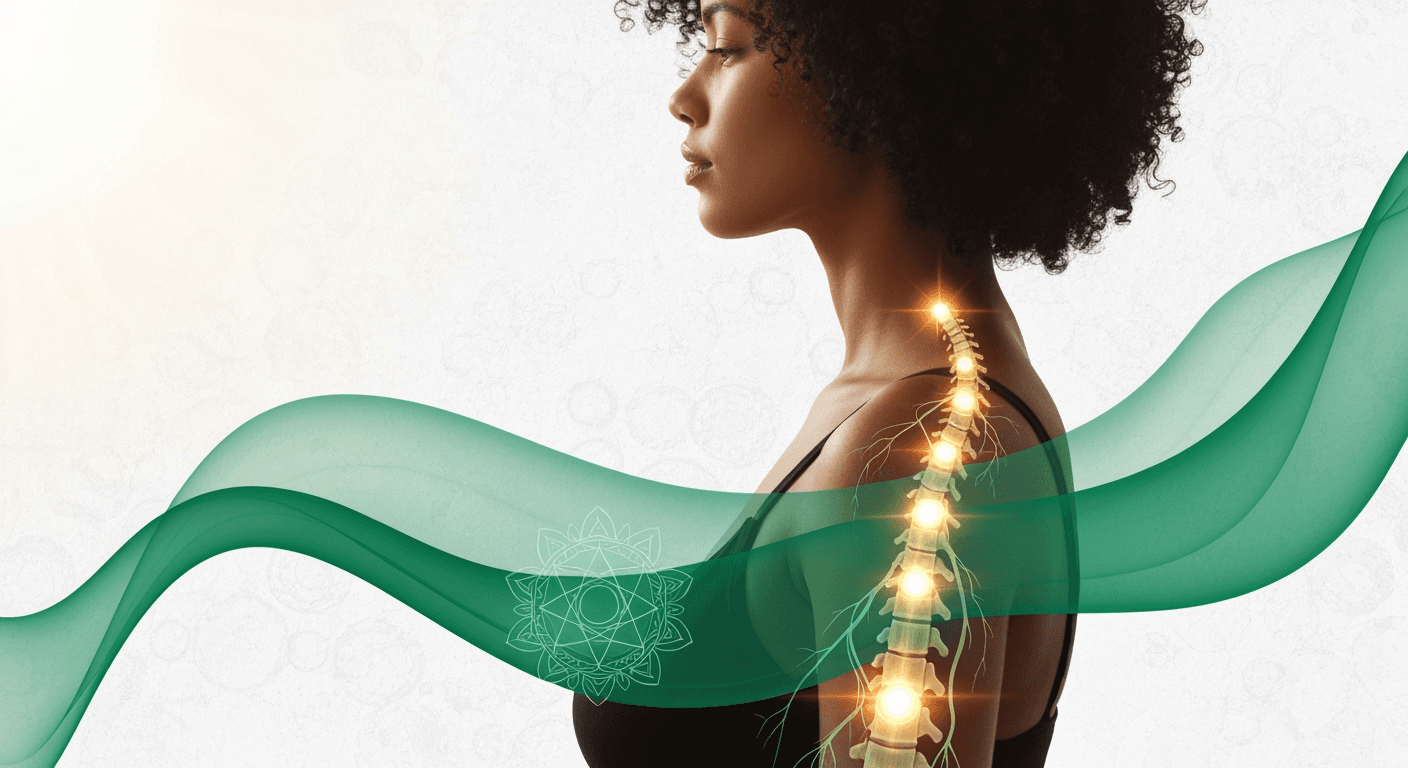
A Complete Mind-Body Awareness Journey
Guided Movement Practices for Nervous System Integration
🌟Welcome to Your Journey
"It is my sincere hope and prayer that this content serves your highest potential and empowered healing."
Knowing what to do to take care of ourselves can be overwhelming. We live in a world where everyone is trying to sell us something different! Drugs and surgeries claim to fix the problem. Many of us feel broken and are looking for a one-time, cure-all solution. And because of this desperation… Everyone is trying to capture our attention, trying to sell us a quick fix.
This is not that. What you put into this will determine what you get out.
I am not selling you a quick fix because I do not believe you are broken. Rather, I am attempting to sell you on yourself. Yes YOU! I want you to show up for your Self with these Mind-Body Rituals day after day, to balance your nervous system, to activate your body, and to release your soul potential.
The Journey Ahead
Becoming our own True Self is a journey and there really are no shortcuts… but hopefully these Mind-Body Awareness tools can be an effective road map for this healing voyage.
I've broken down this series into parts, but they're all going to be interconnected - just like how your body is connected and whole (not broken). Since the nervous system is the communication wiring that makes us so connected, we will use this as our main lens in which we view these practices. We will work together to train the nervous system in a specific, adaptive, and truly holistic way.
It can be simple. All you have to do is follow along and try your best.
With repetition, these practices will stick and you will be able to do them without the video and eventually, without even thinking. So let's begin this journey together. Your best self is your True Self.. so let's get started!
Session Format
Introduction
2-5 min
Warm Up
2-3 min
Breathwork
5-10 min
Movement
25-30 min
Meditation
5-15 min
Goal Time: 1 hour total
🌱Root - Hips & Pelvis
Foundation & Grounding
Understanding the Foundation
The pelvis is the foundation of our spine, which houses the nervous system. We want it to have integrity and be in symmetry. If it is lopsided, rotated, or distorted in some other way – we call this subluxation in chiropractic – then the rest of the spine above has to compensate.
Why does the pelvis get twisted up?
The hips are not moving properly. While we want to have a stable pelvis, we want the ball and socket hip joints to be flexible and dynamic. Most of us are experiencing the micro-trauma of asymmetric hip movement or repetitive sitting on a daily basis.
This means:
- The ball and socket hip joints do not have full range of motion
- There are muscular imbalances from right to left
- The glutes are turned off while the hip flexors and hamstrings are tight
- The sacrum is untucked due to pelvic floor weakness
Key Concepts
Pelvic Floor
A muscle dome beneath your pelvis that you can feel tighten and lift as you engage it
Transverse Abdominis
The main deep abdominal core muscle that we "hollow" to engage - "bringing belly button towards the spine"
Abdominal Hollowing
Creates a lift through the low back that creates safe stability
Root Session Guide
Warm Up
- • Ankle Rolls
- • Windshield Wipers (wide and narrow)
- • Hip Circles with Psoas trigger point rolls
Conscious Breath(5 min)
- • Settle into the Now moment
- • Lower belly & grounding mudra
- • Conscious Intention: What do you want to create in your life? What is your intention for the day or this series?
Movement Practices
1. Abdominal Hollowing
Pulling belly button in towards spine
2. Pelvic Tilt & Lift
• Tucking the tailbone down, flattening low back
• Then, squeezing glutes and pelvic floor to lift hips to ceiling
3. Glute Extension & Abduction
• Forearm/Hand modifications
• Extension: keep knees bent, hollow core, keep spine neutral
• Abduction: keep pelvis square, hollow core, keep spine centered
Keep ourselves honest - do it for the grow not the show
4. Hip Adduction
Feel the lift start from lower core and pelvic floor
5. Psoas Resistance Stretch
• Cloth/cushion modification
• Breathe in: upright long spine, relax (the muscle into elongation)
• Breathe out: lean in, contract (the muscle into resistance)
6. Hamstring Resistance Stretch
Keep slight bend in knee, maintain neutral spine
7. Athletic Pigeon Pose
• Arm/forearm modification
• Bring knee across and down, push knee into ground to resist body weight as you slowly descend
• Knee angle and descent modifications
8. Resistance Butterfly Stretch
Breathe in, lean in, resist as knees slowly drop towards floor
9. Bird Dogs
• Neutral spine, lift hands, basic
• Honor your low back curve - hollowing
10. Hip Abduction Circles
Keep low back honest - neutral stable spine
11. Grounding Grace Core Activation (Standing)
• Heels hug together, pelvic floor engages, hollow, lift through chest
• Plug the shoulders in towards the spine
12. Shoulder Plugs
Shoulder blades depress, armpits tighten, suction cup the GH ball and socket joint
13. Hummingbirds
Shoulder blades roll back and down, neck is tall with slight chin tuck
14. Diagonal Neck Extension
Shoulders plug, follow the movement with chin and chest
15. Air Squats
Hip hinge backwards, engage core, keep a neutral spine
16. 360° Hip Stretching (Standing)
Full range of motion exploration
White Light Meditation
- • On back, knees bent, keep lordotic curve, feeling pressure on S1-2
- • Breathe white light expansion into energy centers
- • Halfway switch to seated
☀️Solar - Diaphragm & Obliques
Core Cylinder & Power Center
Understanding Your Core
Our core is not just the superficial 6-pack abs on the front of our abdomen. No, our core is the incredible cylinder of deep stabilizing muscles that runs all the way around your abdomen, beneath your pelvis, up your spine and chest, and through the shoulders and deep neck.
Core Muscles Include:
- The Pelvic Floor consisting of 23 different muscles
- The Iliopsoas muscle that runs beneath your digestive organs to flex the pelvis and stabilize the lumbar spine
- The Transverse Abdominus activated when we "pull the belly button in" or "hollow" the core
- Internal and External Oblique muscles activated when we "corset" the ribs
- The Multifidi and deep paraspinal musculature activated with extension when we "keep a neutral spine"
- The Diaphragm used to engage other core muscles during exhalation with the "Heimlich" cue
- Deep Chest and Shoulder musculature engaged when we "plug the shoulders" or "hug the midline"
- The Scalene Muscles of the deep neck felt when we "tuck our chin"
The Diaphragm Connection
It's important to note that the diaphragm is actually a component of our deep core. When we exhale, we should feel our ribs tighten inwards – what I will refer to as "corseting". This type of deepening of the core is also accomplished through the oblique muscles.
By corseting across the ribs and Heimlich-ing the sternum in towards the spine, we are able to:
- Stand or sit up straight
- Decompress the vertebral discs
- Activate key stabilizer muscles
- Promote full diaphragmatic breathing
Solar Session Guide
Warm Up
- • Thoracic extension/flexion
- • Lumbar lateral flexion and rotation (sulfi rolls)
- • SCM & Upper Trap passive stretch
- • Conscious Intention: What do you want to create in your life right Now? How can you become more self-aware and self-loving?
Belly Breath(5-1-5-1)
- • Breathing into front, sides and back of diaphragm
- • Flexion/Extension & TL junction Rotation
Movement Practices
1. Sequential Pelvic Lift
• Neutral spine, hips to far wall, corset ribs, plug shoulders
• Slowly roll thoracic spine down, vertebra by vertebrae
2. Pilates Upper T-Spine Lift
• Hug midline, belly in, corset ribs, lift head then upper back
• Hands cradle back of head, elbows in peripheral vision, neck elongated
3. Core Cross Crawl
• Variation options: static, legs, arms & legs
• Diagonal activation to stabilize the spine
4. Front Plank
• Knee/elbow modifications
• Activate glutes, lift hips, plug shoulders down
5. Cat Cows
Flow with breath, engage full spine
6. Side Planks
• Forearm/hand modification
• Suck ribs away from floor
7. Bird Dogs
Engage core, lift right hand and left knee
8. Quad Side Lying Resistance Stretch
• Breathe out: push, resist
• Breathe in: relax, elongate
9. Forward Fold & Halfway Lifts
Hinge at hips, keep spine neutral
10. Windmills
Hinge at hips, keep spine neutral
11. Diagonal Knee Touches
Power it from the core
12. Arm Circles
Hug heels, hollow core, plug shoulders, thumbs up, flip 'em back, smile
13. Thoracic Twists
• Feel whole torso turn on as you twist through thoracic spine
• Slight bend in knees, heavy pelvis, corset ribs
14. Turtles & Neck ROM
Full cervical range of motion exploration
15. Forward Lunges with Twist
• Modifications: chair/furniture, static, static twist, forward movement
• Keep curve in low back
Cool Down & Meditation
- • Psoas/Hamstrings/Pigeon/Butterfly resistance stretch cool down
- • Solar Gold/Lunar White Meditation
- • Side twist cool down with arms overhead
- • Back lungs breathing
- • White light laying, golden light seated
💚Heart-Center - Thoracics & Chest
Coherence & Connection
Heart Coherence
There is a new field of science emerging that is beginning to understand what the ancient teachers have known for centuries… This science is beginning to recognize the immense benefits of increased Heart Coherence.
Understanding Heart Coherence:
- Brain-heart coherence is measured by heart rate variability (HRV)
- HRV is determined by seeing how quickly the heart can return to peace and coherence after the nervous system is exposed to stress
- The heart is the bridge between the brain and body - the heart-center
- The more adaptable it becomes, the more resilience to stress our mind-body develops
The Electromagnetic Heart
Our heart-center generates an electromagnetic field that is 5,000× stronger than that of the brain. This field of energy is transmitted a space of 3 feet or more surrounding and encapsulating our body.
The thoughts we generate and the feelings we experience determine the electromagnetic signature of our field.
Physically, the heart-center consists of: the heart, the lungs, the thymus gland, the sternum, the ribs, and the thoracic spine. We want the thoracic spine to be pliable and open. Closed chests and shoulders represent an anatomy that is disconnected from the heart center.
Opening our heart prepares us to go into a state of loving service from a feeling of abundance. Literally, we have to open our chest, drop our shoulders, and breathe deeply to expand and open this energy. This postural awareness sends a message of wholeness and confidence to the brain.
Heart-Center Session Guide
Warm Up
- • Thoracic extension and flexion, rotation, and shoulder rolls (standing)
- • Side Body Stretches
- • Thoracic ROM seated
Breathwork
Conscious Breath (5-1-5-1)
• Slow flexion/extension thoracic spine
• Rotation (faster breath)
Finding Clarity Breath (3-4-3-4)
• Slow down breathing and heart rate
Movement Practices
1. Pelvic Lift Sequential
Hollow → Corset and Lift through the hips → Elongate the spine
2. Head and Shoulder Press
Press into mat for stability
3. Pilates V Fern Curl
• Squeeze ankles to hug the midline
• Reach arms towards your feet as you Heimlich to lift upper back and neck together
4. Core Cross Crawls
• Hollow the abs and keep a neutral spine
• Bring knees to 90-90
• Hug an imaginary beach ball with your arms
Keep gap between low back and floor - do it for the grow, not the show
5. Cat Cows
• Breathe in: lift from the chest, let belly fall through trap door
• Breathe out: Heimlich the sternum and tuck chin, hollow core and tuck tailbone
6. Bird Dogs
Hollow the core → Hug the midline → Keep neutral spine
7. Plank & Side Plank
Maintain full core engagement throughout
8. Psoas/Hamstring Resistance Stretch
Apply resistance stretch principles
9. Shoulder Plugs
Engage shoulder girdle deeply
10. External Rotation Circles
• Hug midline with Pilates V
• Thumbs up, flip it around
• Plug shoulders, small circles backwards, smile
11. Shoulder Rolls
Release tension, open chest
12. Sun Gods
Both directions, abduction and flexion movements
13. Thoracic Twists
Keep core engaged throughout motion
14. Hummingbirds
Hug midline → Plug shoulders → Roll shoulder blades back and down
15. Diagonal Neck Extension
Track the movement with chin & chest
16. Squats - Merkaba Squats - Squats
Progressive squat variations
17. Sun Salutation 1 - Warrior 2/3 Transitions
Flow through yoga sequence
18. Lateral Hamstring/TFL Supine Belt
Supine stretch with assistance
White Light Heart Center Meditation
- • Gratitude and Elevated Emotions
- • Focus on Light potential
🗣️Throat - Cervicals & Extremities
Awareness & Expression
The Cervical Spine
The cervical spine has the most range of motion in the whole spine. Unfortunately, because of this it is often abused. We have to respect our neck and feed it healthy motions on a regular basis, otherwise we end up with pain, dysfunction, and hyper or hypo mobility.
Bioenergetic Awareness
Bioenergetically, the throat and the neck is the place of our neutral awareness - our initiation center where we make conscious decisions from. Here, we have a capacity to rise above the emotions - operating from a higher sense of Consciousness. However, we can't utilize this advanced function if our neck is chronically in pain. We have to break out of our reactive patterning if we want to create a real change in our life.
This is why the breath matters.
The Power of Breath
"Breath is the messenger of awareness between the mind and body. Where there is no breath, there is no awareness. Where there is no awareness, there is no ability to make a change." - Dr Wade Port
- Breath is one of the only physiological functions we can choose to consciously control
- Becoming present with the breath enables us to regulate our nervous system
- We can integrate life experiences without becoming reactive
- We can become more aware of energetic blockages and distortions
- We can use breath and movement to release potential energy
- We can generate physiological peace by activating the parasympathetics through belly breathing
- We can develop neurologic strategies of awareness around emotional regulation
Throat Session Guide
Warm Up
Cervical Range of Motion:
- • Flexion & Extension
- • Lateral Flexion (left & right)
- • Rotation (left & right)
- • Diagonal Extension
- • Protraction & Retraction
- • Turtle Circles
Breathwork
- • The Clarity Breath
- • Sapphire Grace Breath
Movement Practices
1. Toe Raises
Toe ups with spread pads
2. Standing Hug Midline Tricep Extensions
Engage core while extending arms
3. Knee Glute Ups
Activate glutes from kneeling position
4. Bird Dog Sequential
Progressive engagement sequence
5. Hip Stretches 360° (Standing)
Complete hip mobility exploration
6. Fern Curl - Arms Reach/Behind Neck
Core engagement variations
7. Diagonal Crunches (Supine or Standing)
Oblique activation
8. Diagonal Extension + Arms + Squats
Full body integration
9. Standing Nerve Flossing
Neural mobility work
10. Standing Trigger Point Rolls
Release tension patterns
11. Cervical Resistance Stretches
Apply resistance principles to neck
12. Pec and Forearm Trigger Point Rolls (Cool Down)
Release upper body tension
Meditation
- • Vishoka White Light Meditation with extremities
🌀Deep Core - Psoas & Lumbars
Energy Reservoir & Emotional Release
The Anterior Fascia
The front part of our body is an energy reservoir for our human experience. A lot of times, stuck emotions can show up as stuck energy, which manifests as stuck tissue in the deep anterior fascia.
From the tongue, through the scalenes, down the rib muscles, through the diaphragm and into the psoas we go, allowing these deep tissues to naturally unfold with ease and grace.
Mind-Body Relationship
The body is a complex weaving of tissues that are all in relationships with one another, just like how we are in a relationship with ourself. We want to have a fluid, natural movement of the tissues just like we want to have a healthy flow of emotional energy processing through the front body. These two go hand in hand which is why breath and practicing honest listening is so essential for the mind and body.
Resistance Stretching as Emotional Work
With all the resistance stretching, what we are really doing is facilitating a deeper listening relationship with our emotional self. Beneath the surface, our body is holding onto tension that wants to just be seen. We don't have to release it, push it, or force it to come out of hiding. We can simply lean in and listen for the okay, for the yes, for the rapport and self trust that can occur between the egoic mind and the body.
As this honest listening occurs in real-time, we will know exactly how much or how little to stretch or activate a tissue.
Deep Core Session Guide
Warm Up
- • Egg Rolls and Rocks
- • Sulfi Rolls
- • Chin Wiggles and Face Release
Breathwork
- • Heart-Center: Higher, Middle, Lower Listening
Movement Practices
1. Prone Scalene Lifts
Activate deep neck flexors
2. Prone Diagonal Extensions
Full body engagement on belly
3. Standing Turtle Tucks
Cervical awareness standing
4. Jaw Wiggles & Tongue to Roof
Release facial tension
5. Scalene Resistance Stretch
Deep neck release
6. Hummingbirds
Shoulder blade engagement
7. Pectoral Resistance Stretch
Open chest with resistance
8. Front Chest Fascia Down Dog Chair Stretch
Deep anterior chain opening
9. Thoracic Rotations
Mobilize mid-spine
10. Diagonal Cross Crawl Appreciation (Standing)
Integrate brain hemispheres
11. Forward Fold and Roll Ups with Tricep Extensions
Spinal articulation with arm work
12. Supine Bicycles / Swimmers
Core integration on back
13. Psoas Resistance Stretch
Deep hip flexor release
14. Core Cross Crawl
Diagonal core patterning
15. Advanced Psoas/Quads Stretch
Deep anterior chain opening
16. Hamstring Stretch
Posterior chain release
17. Down Dog Walk Out
Full body integration
18. Shin Kneel Stretch
Lower leg release
19. Jaw, Facial Muscles, Humming, Shoulders, SCM Massage
Self-massage and vagal stimulation
Meditation Sequence
Pink Love Meditation
• Facial relaxation and vagal cues
• Honest listening
Golden-White Light
• Expansion and contraction in lower diaphragms and deep core
• Abundance manifestation
• Worthiness
• Grace
👑Crown - Nervous System & Cranium
Integration & Higher Consciousness
The Central Nervous System
Our CNS consists of our brain and spinal cord. Within the spine and the cranium is the sensory-motor processing system. Information (sensory) from the body is processed so the mind (brain) can coordinate an appropriate response (motor).
We can "feed" our brain healthy inputs through conscious breathing, quality movement, and perhaps the best input of all - no input.
Technology & Nervous System Balance
In our technologically addicted society, we are ingesting too many stimuli on a regular basis. Social media, news, television, youtube, and many more forms of information are constantly bombarding us. If we are not careful, we allow ourselves to be conditioned to our technology.
Instead, we can condition our external life towards the internal experience we want to generate.
Creating Nervous System Coherence
If we truly want more peace, then we will put away the phone two hours before bed. If we want to feel more connected, then we will create time for breath and meditation at regular intervals throughout our week.
In this way, through our conscious intention (mind) and physical follow through (body), we create nervous system coherence (awareness).
Crown Session Guide
Warm Up
- • Craniosacral Pump (Cat Cow)
- • Cranial Bone Palpation
Breathwork
- • Finding Clarity Breath (4-3-4-3 AND 6-4-6-4)
Movement Practices
1. Neck Fern Curls
Cervical flexor strengthening
2. Core Rolls
Spinal articulation
3. Core Cross Crawl
Brain hemisphere integration
4. Superman Diagonal & Cross Crawls
Posterior chain activation
5. Bird Dog Sequential
Progressive stability work
6. Glute Extensions & Abductions
Hip strengthening
7. Adduction Leg Lifts
Inner thigh activation
8. 360° Hip Stretching
Complete hip mobility
9. Diagonal Extensions with Ball - Group Activity
Partner or group integration work
Three Centers Meditation
Focus on 3 Energy Centers:
1. Pineal & Pituitary
• Intention in pituitary
• Allowing and surrender in pineal
2. Heart-Center
• Grounding elevated emotion through heart
3. Root
• Gratitude in root
Anchoring through three centers - intention, allowing, and gratitude
Your Journey Continues
"Every moment of every day is either being consciously chosen or unconsciously unchosen."
Practice Tips for Success:
- ✨ Start with 10-15 minutes daily and gradually build
- ✨ Create a dedicated space for your practice
- ✨ Use modifications as needed - honor your body's current state
- ✨ Focus on quality of movement over quantity
- ✨ Keep a journal to track your progress and insights
- ✨ Remember: consistency over perfection
- ✨ This is for the grow, not the show
With repetition, these practices will become second nature. Trust the process and trust yourself.
Your best self is your True Self. Keep showing up!
Neurospinal Reboot Series - Mind-Body Awareness Guide
Created with love by Dr. Cameron Brownley
Shine Family Chiropractic | True Self Series